
Everyday cycling with teenagers
Last summer, our first baby (now 18) left home.
And it made me realise that family cycling doesn’t stop when children grow up - it just changes.
Cycle Sprog offered me the chance to write articles to pair with an academic paper I've authored for Active Trave Studies. That article is more technical; these ones are much more personal.
There’s less written about cycling with teenagers and older children than about cycling with small kids, so I’ve written mostly about the practical things we’ve found useful as our children have got older, especially when they’re travelling independently, without a driving licence, and navigating the challenges of teen life.
About the author
She has spent nearly two decades cycling, walking, running, catching buses and trains and, in the last five years, wheeling journeys, with varying numbers and ages of children - which inevitably ended up involving a lot of different kit and a lot of campaigning for improved accessibility! In between that, she enjoys reading, board games, gardening and playing music - and eating a lot of cake.
Off on their own – independent travel without a driving licence
Our eldest child (Kid1), who is now 18, is one of the majority of young adults who do not have a driving licence.
With only under a third of 17 to 20 year olds in the UK holding a driving licence, our family's story is likely to be repeated up and down the country.
During autumn 2024, he was applying for engineering degrees and apprenticeships.
Universities are generally in cities or at least acknowledge non-drivers. Engineering industrial sites, on the other hand, are mostly isolated and nowhere near cycling or public transport routes.
Companies offering apprenticeships always seemed to assume applicants would drive. That’s unfair for young adults, and limiting for companies too.
Kid1 has been combining cycling with rail and bus for years, and, with backup, could handle planning logistics for an apprenticeship alongside studying and playing in (too many) bands.
For each apprenticeship he applied for we planned the travel – including the degree study and interview travel.
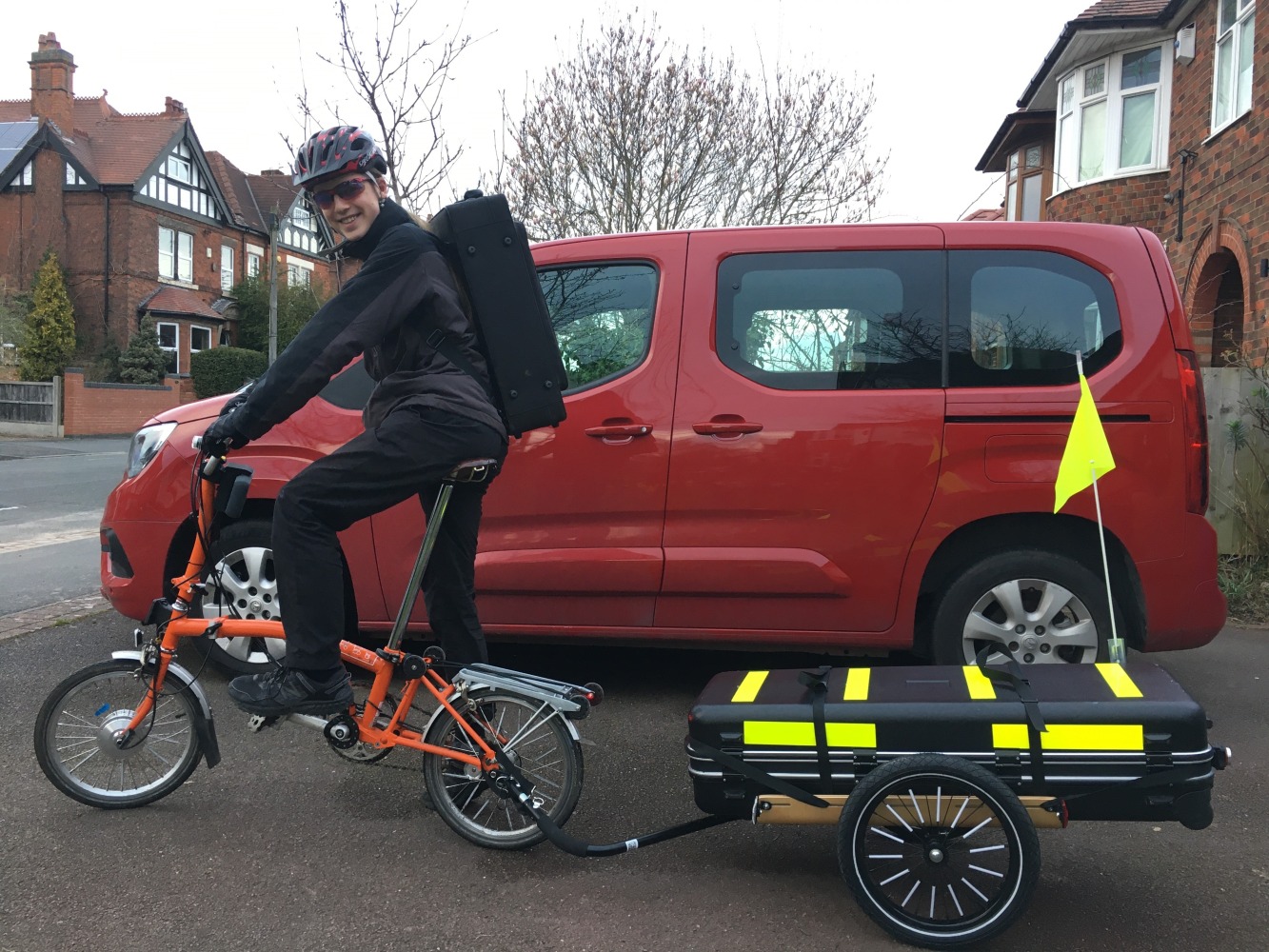
Our initial plan was to get him a refurbished e-Brompton. We’ve been sharing my e-converted Brompton between four of the family for years: it’s worth its considerable weight in gold for awkward combined cycle/public transport trips.
The cost of owning and insuring a car for an under-21 would be at least as much as buying an e-Brompton every year. A folding bike would also work wherever you live.
In the end, the apprenticeship he’s got is based in a town, with good rail links to the degree study college. The train is quiet enough to take a standard bike, and the HMO (houseshare) he’s renting in has a shed. He’s chosen to stick with his old bike for now. Getting to this comfortable situation was made much easier by our family’s wealth, social and educational privileges.
Tip 1: E-bikes and folding bikes massively expand travel options for teenagers
Children can ride e-assist pedal cycles solo from the age of 14, and most folding bicycles are easy to adjust between people of very different heights.
Electric cycles open up complex journey options, including when you don’t have time, energy or inclination to drive them. Sharing our e-converted Brompton plus a trailer has let Kid1 and Kid2 combine cycling with public transport, even with heavy luggage.
Tip 2: Location sharing can reduce parental stress
Sharing phone locations has been a huge stress-reducer for us as parents of cycling teenagers.
We’ve only needed to use it “for real” once – to rescue an injured Kid2 who’d fallen and torn a thumbnail off and was so woozy with pain he could only report he was “near a yellow thing” (it was a metal arch into a car park!). But it’s reassuring to be able to check things look OK, especially at night or when they’re further afield… and especially if they forget to message!
When can I go by myself?! – learning to make independent (or supported) journeys
Over the pre-teen and teen years, conflicting schedules, needs and my limited mobility since 2020 have meant that even with a 7-seater car and 2 adults available, we simply couldn’t get every child everywhere they wanted to be.
Once Kid1 and Kid2 each reached 8-years-old, I found myself saying “Well, if you can get yourself there, I can pick you up?” a lot - first for walked journeys, then cycled ones.
Encouraging independent travel from a young age was done for practical reasons – and it was scary for us parents, although Kid1 and Kid2 were generally proud about it.
There was quite a bit of judgement from other adults (and jealousy from other children!), but those who knew our family were generally relaxed and understanding.
We practised routes at quiet times such as weekends – and were fortunate that Kid1 was very mature.
Once Kid1 and Kid2 needed to make journeys together, Rather Bossy Kid1 feeling responsible for Slightly Wappy Kid2 did lead to a couple of blazing rows – but they’re usually friends, and understood that if they couldn’t travel safely together unsupervised, they simply couldn’t get places at all.
Tip 3: One-way supported journeys can build independence
One-way independent journeys with adult support the other way can work well – to teach a child a new route, for late events, longer distances, if you’re watching a concert too but don’t want to entertain fractious toddlers for the whole set-up time...
Trips can have a drop off by a parent cycling, sharing public transport or driving in one direction, and the child or children completing the trip independently by any usable mode in the other.
Or you can transport a child some days, and they can travel independently others.
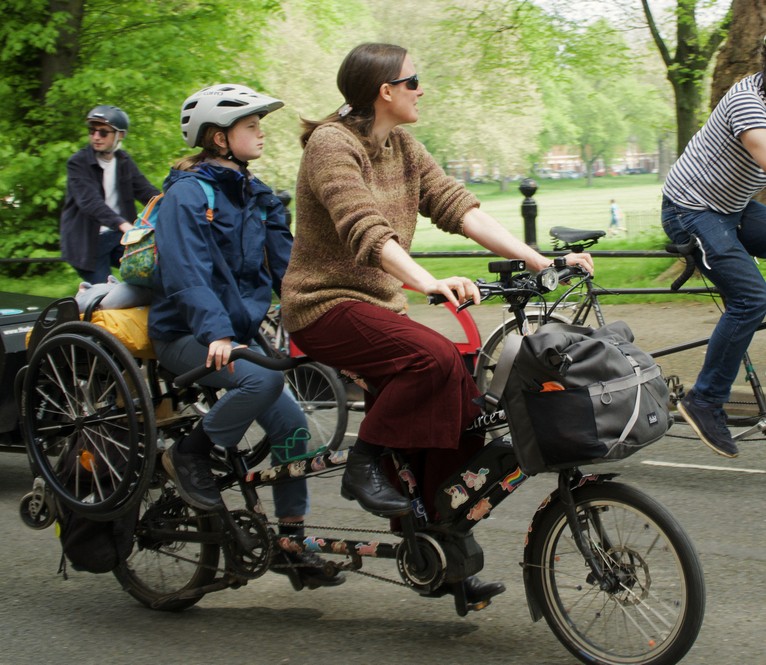
Kid2, who’s now 16, still gets lifts on the tandem every so often – sometimes logistics mean it makes more sense. They also sometimes get lifts in the car – which is exactly the same, but people consider it much more normal!
Pavement cycling as a necessary evil
We don’t live somewhere with good cycle routes so for much of the time from toddlerhood through adulthood, our kids have had to ride sections on pavements or not ride at all.
Once they were age 5, on bikes with gears, Kid1 and Kid2 could ride next to a parent on roads. But there’s a huge difference between a 5-year-old riding next to an adult and a 10 or 12-year-old riding alone amongst distracted, dangerous drivers.
We trained all our children to give way to pedestrians on all route types, shared-use or not. We also trained them to cycle on pavements by default for many regular routes, and whenever they felt unsafe on the road.
Kid1 and Kid2 now ride almost entirely on the road – but there are some roads which still aren’t safe to ride on, so they ride slowly or walk on the pavement for those.
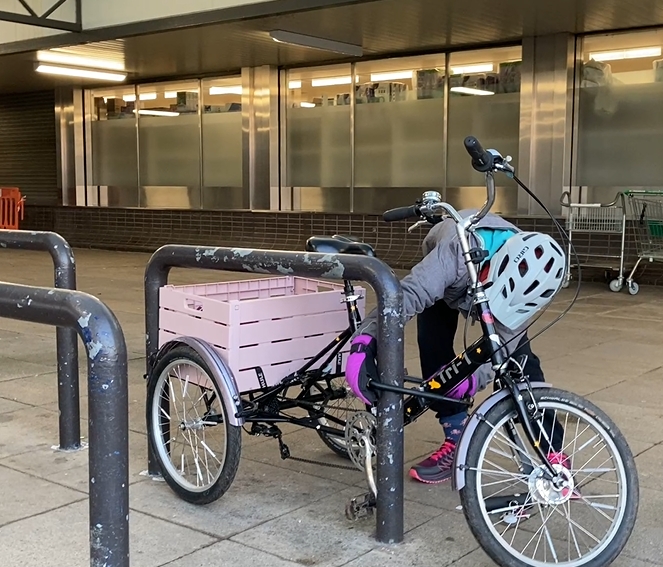
Kid3 especially still often needs to ride on the pavement, due to her disability, even when with an adult. This requires a lot of stopping and moving aside for pedestrians – she’s adult-sized, so we take up a lot of space.
I think white, middle class privilege has a lot to do with why we’ve felt telling our teens to cycle on pavements is a safe option – and I wouldn’t judge someone for making a different call, including not being happy for their teens to cycle at all.
Everyday family cycling from toddlers to teens: why it’s not always easy (and that’s OK)
There are a few things which make everyday family cycling journeys easier over the years, which has helped us progress through to the teenage years.
You don’t need to have all of them, but if you don’t have enough, then some cycling trips are going to be difficult or impossible.
What are those things?
- Time and energy – To source equipment, learn or teach new skills, work out routes, make trips. We’ve often had time and energy to handle new family stages in cycling as they’ve arisen, but sometimes we haven’t. That’s OK. We’ve tried again when we’ve had capacity.
- Money – To buy or rent cycles and other kit. Few organisations provide free cycles – and fewer provide adapted cycles like tandems and trikes, or e-bikes. For us, having enough money to buy cycles that might work without risk or other compromises is a huge privilege.
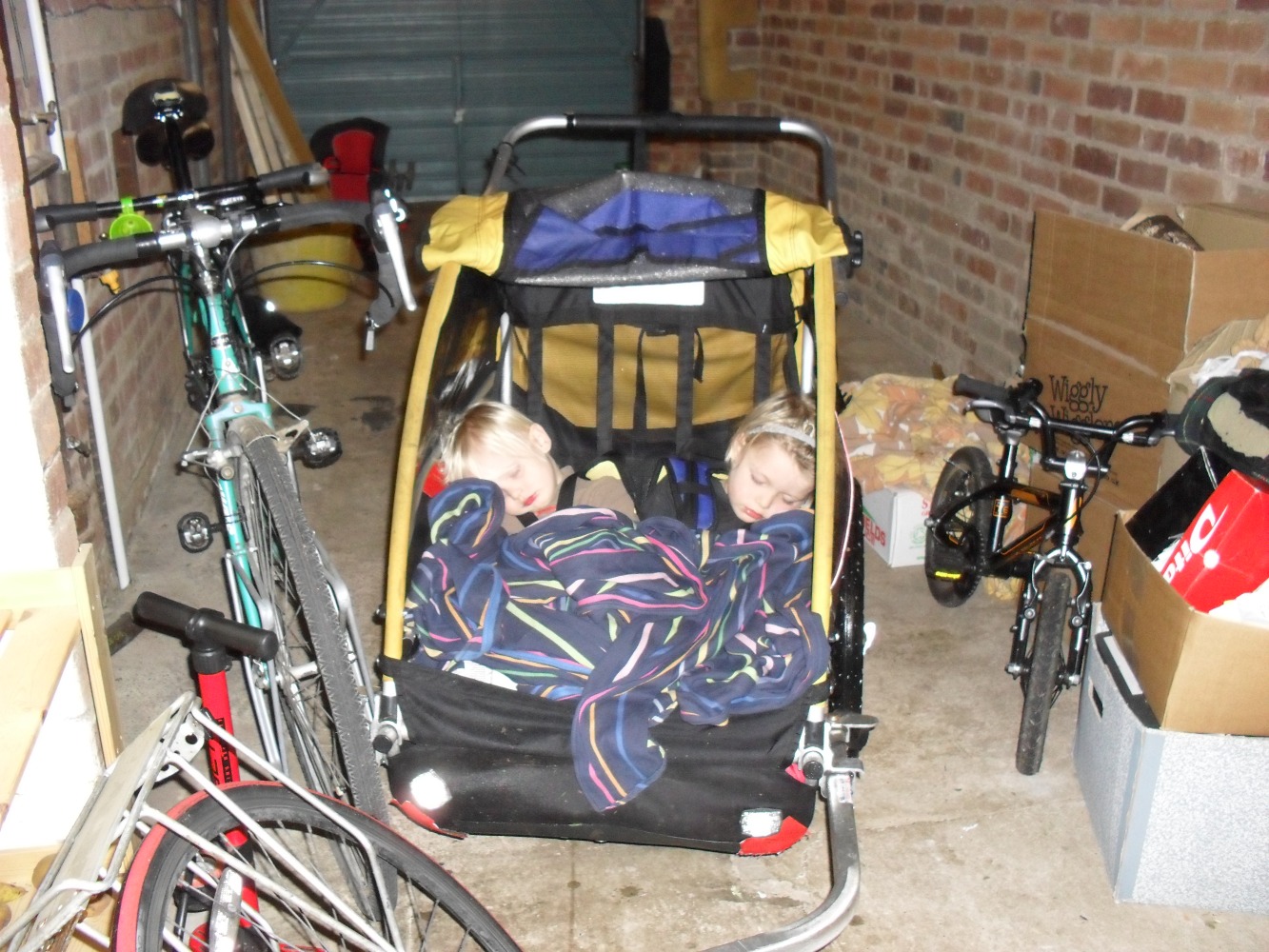
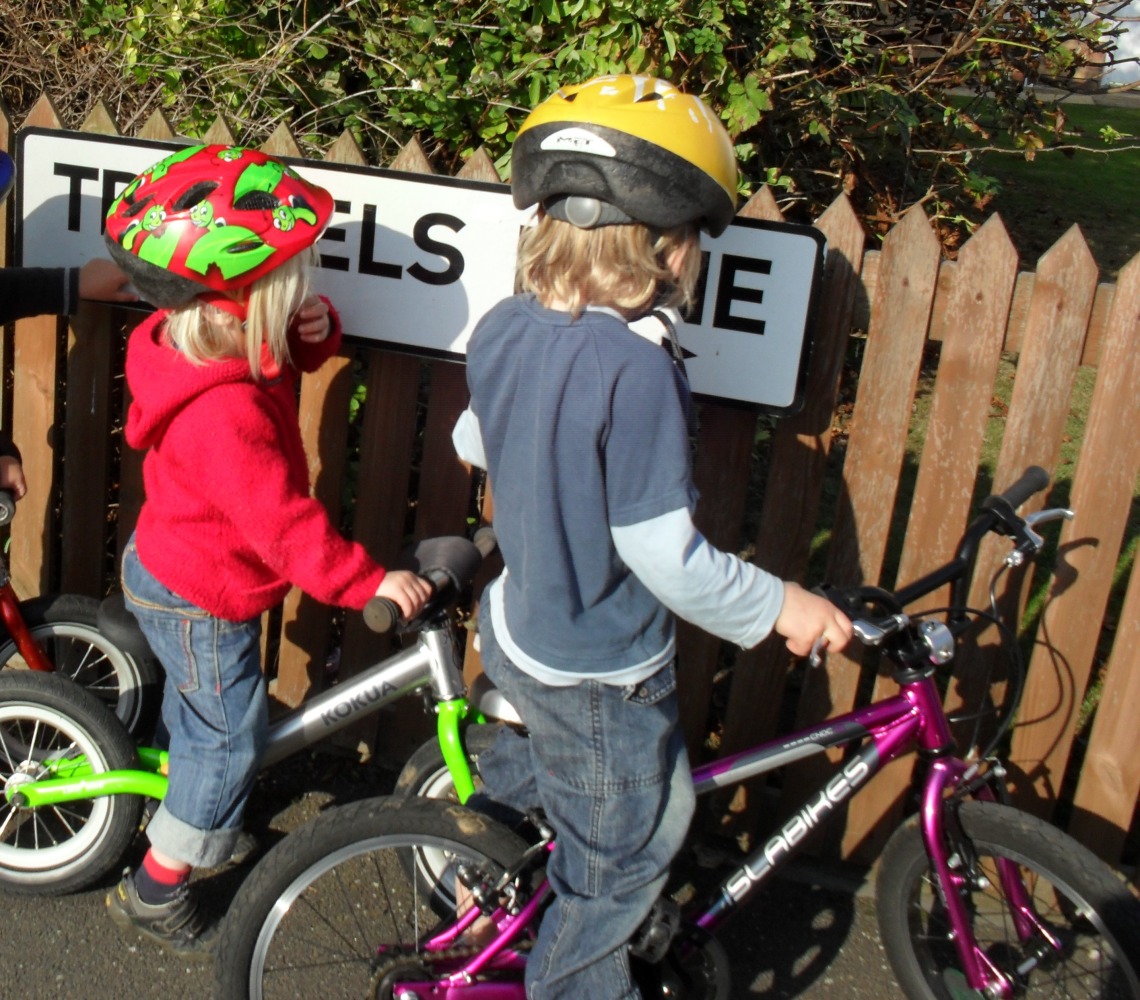
- Space – For storage, and safe, accessible routes to use. We’ve been lucky to have space at home, but not so lucky with the safe routes…
- Support – From family, friends and a wider network. Offers of childcare, experience, equipment, and people being generally positive about cycling have really helped us.
- Experience – We were fortunate to start parenting as non-disabled, experienced cyclists, learn how to teach cycling with non-disabled children first, then learn to cycle with Disabled children and with me as a Disabled adult. If you’re only having to learn little extra bits at a time, it’s obviously going to be easier than learning to cycle as an adult with children.
- Physical, emotional and cognitive capacity – Similar to energy - and can be taken up by a whole range of things, positive and negative. “I can’t face that at the moment” is OK, too!
Image credits
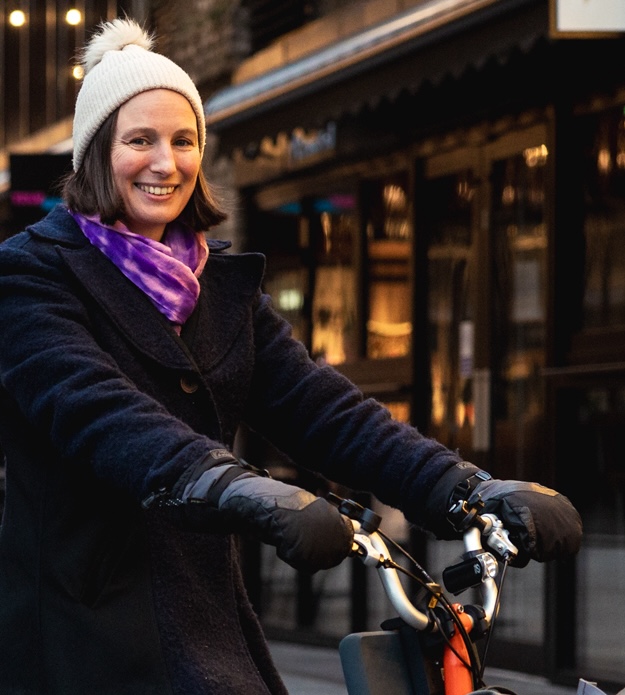
- Image of Kate in intro: Credit Loud Mobility (She's Electric)
- Image of Kate and daughter on tandem: Credit Hardy Saleh
Before you go…..
We hope you enjoyed this guest post from Kate Ball. Family cycling doesn’t end when children grow up, and it rarely looks tidy or straightforward. It shifts with age, independence, disability, energy, and circumstance, and what works at one stage may stop working at the next.
Every family’s experience is shaped by privilege and by challenges, but I hope Kate's story offers reassurance that it’s OK for family cycling to be imperfect, adaptable, and creative at times. What matters is finding what works for your family right now, and being willing to change it as your children, and you, change too.
Government consultation on mobility aids
If you use a mobility aid, like an e-bike or trike, or know someone who does, Wheels for Wellbeing has pulled together a really strong set of resources on the government’s current mobility aids consultation, which closes on 22 April 2026.
The consultation campaign page includes webinars, recordings, clear explainers and practical guidance on how to respond, and it’s genuinely important for anyone who might use a mobility aid at some point in their life, or who shares streets, paths and public spaces with people who do (which, realistically, is all of us).
Other articles you might be interested in:
- How to start cycling with a small child
- Cycling with teenagers: everything you need to know
- Best electric longtail cargo bikes
- Cycling with older kids who have a disability or special needs
- The best rear bike seats for toddlers and small children
- The best front bike seats for toddlers and young children
- Best bike trailers
Comments